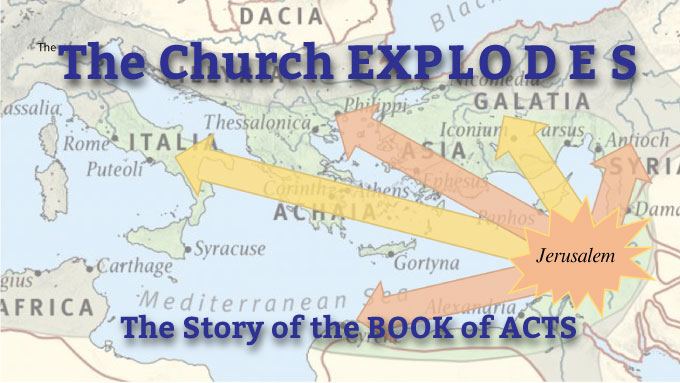
Faith in Jesus as the Messiah was spreading rapidly in Jerusalem and the surrounding area. The Jewish leaders had already resorted to threats in order to silence the apostles, but it did no good. Now they tried imprisoning them, but as we'll see that didn't work either. First, because God released them from prison, and second, because the apostles chose to put obeying God before obeying man and were willing to pay the price for doing so. The Holy Spirit can help us do the same.
Satan tried to stop the church from the outside, by putting governmental pressure on the apostles. That failed. As we'll see, Satan isn't finished trying to shut down the church. This time he uses two people inside the church to try to discredit the church and ruin its fellowship. God, however, knows what is going on, and the result does not turn out to be what Satan, or the couple involved, planned for.
Peter and John have been released by the Jewish leaders but threatened to stop speaking about Jesus. They return to the gathered believers and the question had to be, "How will they respond? How will they react to the orders and threats that had been given to Peter and John?" What they did and how God responded to it demonstrated that they were going to be unstoppable. That's how every church today should be.
Peter's preaching after Jesus' healing of a lame man in the Temple got him, John, and the lame man held in custody overnight. We get to see what happens during their hearing before the rulers of Israel in this passage. In brief, the hearing didn't turn out at all as the Jewish leaders planned. Peter and John left the court determined that men would not silence them or the truth they were declaring. Their Spirit-given boldness is just what we need as we face those who are trying to silence the church today.
After Pentecost, the disciples might have wondered what might come next. Would God just add to the church a few at a time? Would the church settle down and focus on disciplining those who were saved, praying, worshiping, and doing ministry, or did God have something else in mind? We'll find out that God did have something else in mind. The explosive days of the church's growth were not over. One of the miracles the apostles did led to the next major opportunity to share Jesus in Jerusalem and the results were, once again, dramatic. If we think God is somehow finished with us or the glory days are behind us, perhaps we should think again. God isn't finished until he is finished.
What did the 3,000 new Christians do after they were saved and baptized? Did they go home and enjoy their new relationship with god privately? Did they go back to normal life just grateful their sins were forgiven? We're going to find out and in doing so discover one of the secret sources of power in the early church.
After the Holy Spirit came to indwell the believers at Pentecost, they exuberantly began to praise God in languages they had never learned. This led the thousands of people who were visiting Jerusalem from around the Roman Empire to react in two different ways. Some were astonished to hear Galileans speaking in their tongue. Others accused the believers of being full of new wine. As we open to the text today, someone is about to step forward to correct that false accusation and explain the real meaning of what was going on. By the end of his explanation, 3,000 Jewish people will chose to become followers of Jesus of Nazareth and were baptized. The explosion of the church into the Roman world had begun, and how it happened is full of instruction for us today.
The pouring out of the Holy Spirit upon all people was an event predicted in the Old Testament and brought nearer by John the Baptist's revelation of Jesus as the one who would baptize with the Holy Spirit. Jesus promised to send the Holy Spirit to dwell forever with the disciples after his ascension. The disciples, and others, have been waiting in Jerusalem for God to fulfill this promise. It is now the day of Pentecost and Jerusalem is filled with Jews from all over the world. Something dramatic happens in the upper room where the disciples are gathered, then spills out into the streets of Jerusalem. The promised Spirit has come! The church is ready to explode.
While spending much time praying together as they waited for the coming of the promised Holy Spirit, Peter's study of the scripture lead him to see that the loss of Judas Iscariot to the apostolic leadership team was not only foreseen in the Old testament, but his replacement was commanded there. In this passage we see how the gather believers went about filling the hole left in the leadership team by the defection and death of Judas. We get to learn from the early church some practical lessons on church life from this.
The disciples watched as Jesus ascended into heaven and then returned to Jerusalem to wait for the promised coming of the Holy Spirit. They didn't know how long they were going to have to wait. What would they do in the meantime? It turns out that what they did on this occasion became a pattern that the early church followed throughout its rapid expansion. It is a pattern that healthy, growing churches follow today. We'll discover it here.
The explosion of the church across the Roman world in the first thirty years after Jesus' resurrection followed a strategy that involved just three simple things: a person, a power, and a plan that Jesus gave to his disciples before he ascended. The modern church can't do better than God's original strategy mapped out in this week's passage. You'll have a chance to step forward in this plan today.
In thirty years the church went from a few hundred Jewish believers located primarily in Judea and Galilee to tens of thousands of both Jewish and Gentile believers in North Africa, the Middle East, Asia Minor, Greece, and Italy. Churches existed in small towns, major cities, and the capitol of the Empire, Rome. Poor people, wealthy people, slaves, and political leaders had become followers of Jesus. There is just one book of the Bible that traces part of this explosive development. It is the New Testament book of Acts and in this message we begin our study of the explosion of the church by getting introduced to this book, its author, its purpose, and some of its themes. We'll also get a glimpse at part of the dynamic that lay behind this First Century explosion and see what we can learn about having a transforming impact on our world today.
Christmas and the feeling of joy should be inseparable when we realize what happened at the first Christmas. Joy was the theme of the angel when he announced Jesus' birth to the shepherds, and joy was experienced by everyone who saw the baby Jesus and understood who he was. The carol Joy to the World is sometimes said not to be a song about Christmas. While it speaks of things that are not yet universally and fully experienced, it is firmly based on Luke 2:10-11 and rightly expresses our joy at the birth of Jesus. We conclude our reflections on the carols of Christmas with this beloved Christmas carol.
How did a poem written by a non church-going French man become one of America's most beloved Christmas carols? Why did its message offend churches throughout the American South? What message does it contain that is relevant today? Why is it that we respond so powerfully to it whenever we sing it? These are questions for this week's message in our series, the Carols of Christmas.
Any time angels show up it is a big deal. They showed up a number of times before Jesus was born and then showed up in vast numbers when he was born. Why were they there? What was their message? Does it matter today? We'll consider these questions in this week's message on the Carols of Christmas.
In this series on the carols of Christmas we'll explore the stories behind some of our best-loved Christmas music. This week: O Come, O Come Emmanuel, a hymn based on ancient Latin texts. The title and first verse reflect an ancient prophesy about someone who'd be born and bear the name Emmanuel, or God with us. Who could this be? The Christmas story makes the identity of this one clear. We'll learn how we can celebrate the astonishing truth that God came to be with us in his Son, Jesus Christ, and we'll learn how that truth can change the way we live today.